Ashwagandha and L Theanine for Sleep: 5 Proven Nighttime Facts (2026)
If you struggle with nighttime restlessness, sleep-onset insomnia, or waking up feeling exhausted at 3:00 AM, utilizing ashwagandha and l theanine for sleep provides an evidence-based, non-habit-forming botanical solution for restoring deep rest architecture.
Executive Quick Answer: Can You Use Ashwagandha and L Theanine for Sleep?
Yes, taking ashwagandha and l theanine for sleep creates one of the most effective synergistic nighttime stacks available in functional medicine. While L-Theanine (200 mg) quietens nocturnal racing thoughts, reduces sleep latency, and induces soothing alpha/theta brainwaves within 45 minutes, Ashwagandha (300 mg to 600 mg) blunts midnight cortisol surges, increases slow-wave deep sleep (NREM Stage 3 and 4), and eliminates next-day grogginess without the dependence risks of synthetic melatonin or pharmaceutical sedatives.
Table of Contents: Sleep Architecture & Nighttime Stacking
- 1. Sleep Architecture: NREM Slow-Wave vs. REM Optimization
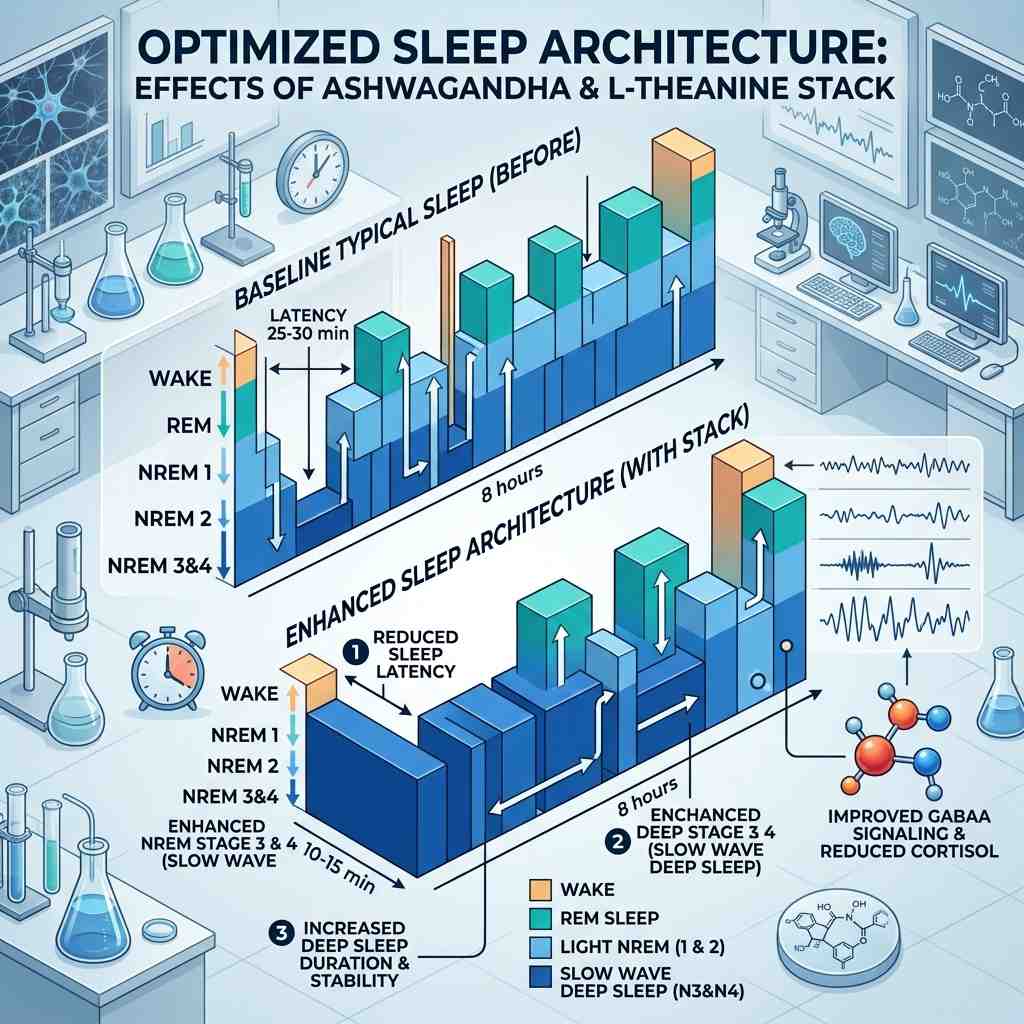
- 2. Sleep Stage Comparison: Baseline vs. Dual Nighttime Stack
- 3. Triple Synergy: Adding Magnesium Glycinate & GABA
- 4. Step-by-Step Evening Dosing & Timing Protocol
- 5. Why This Stack is Superior to Synthetic Melatonin
- 6. Frequently Asked Questions (FAQ)
1. Sleep Neurobiology: How Ashwagandha and L Theanine Modulate Rest
To understand why ashwagandha and l theanine for sleep works so effectively for chronic insomnia, one must evaluate how the human brain transitions into rest. Healthy sleep is not merely a state of unconsciousness; it is an active neurochemical process governed by GABAergic inhibition and nocturnal cortisol suppression, documented in sleep research on PubMed (National Institutes of Health):
- L-Theanine (Sleep-Onset & Alpha-Wave Modulation): Ingesting 200 mg of L-Theanine blocks glutamate receptors in the ascending reticular activating system, preventing hyper-arousal and racing mental dialogue. It facilitates an effortless shift from agitated beta waves (13–30 Hz) to calming alpha/theta waves (4–12 Hz), significantly shortening sleep latency (the time it takes to fall asleep).
- Ashwagandha (Deep-Sleep Duration & Cortisol Blunting): The triethylene glycol and withanolides in standardized Ashwagandha interact directly with GABA-A receptors while suppressing late-night ACTH pulses from the pituitary gland. In clinical polysomnography studies, Ashwagandha increased total sleep time and dramatically improved NREM Stage 3 and 4 Slow-Wave Sleep (SWS)—the physical restorative phase where human growth hormone is released and cellular repair occurs.
To understand how each compound functions individually during daytime stress, read our comparative analysis on Ashwagandha vs L-Theanine for acute anxiety and cortisol.
2. Sleep Stage Comparison: Baseline Sleep vs. Dual Nighttime Stack
| Sleep Architecture Metric | Baseline Fragmented Sleep | With Ashwagandha and L-Theanine Stack |
|---|---|---|
| Sleep Onset Latency | Delayed (30–60+ minutes of tossing/turning) | Significantly Reduced (10–15 minutes) |
| NREM Stage 3 & 4 (Deep SWS Sleep) | Low (Under 10% of total sleep time) | Enhanced (18%–25% of total sleep time) |
| Nocturnal Cortisol Spikes (3:00 AM Waking) | Frequent nighttime awakenings with racing heart | Blunted; steady uninterrupted sleep continuity |
| REM Sleep Quality & Dream Vividness | Suppressed or disrupted by stress hormones | Balanced; smooth transition across sleep cycles |
| Morning Next-Day Grogginess | Common brain fog from broken sleep cycles | Zero hangover; waking refreshed with clean energy |
3. Triple Synergy: Pairing with Magnesium Glycinate
In advanced sleep clinics, combining ashwagandha and l theanine for sleep with chelated magnesium forms represents the gold standard in non-pharmaceutical sleep medicine:
- Magnesium Glycinate (200 mg – 400 mg): Magnesium serves as an essential cofactor for the conversion of tryptophan into 5-HTP and melatonin, while glycine acts as an inhibitory neurotransmitter in the brainstem, naturally lowering core body temperature by promoting peripheral vasodilation.
- The Triple Cascade: L-Theanine quiets cortical mental activity, Ashwagandha suppresses nocturnal stress hormones, and Magnesium Glycinate relaxes physical somatic musculature.
4. Step-by-Step Evening Dosing & Timing Protocol
To maximize the clinical efficacy of ashwagandha and l theanine for sleep, timing your intake with your circadian sleep-wake schedule is vital:
Phase 1: 60 to 90 Minutes Before Bed (Dinner Window)
- Ashwagandha (KSM-66® or Sensoril®): 300 mg to 600 mg taken with your evening meal or a light fat-containing snack. Sensoril is particularly favored in the evening due to its higher withanolide glycoside content, which produces deeper muscular relaxation.
Phase 2: 30 to 45 Minutes Before Bed (Wind-Down Window)
- L-Theanine (Suntheanine®): 200 mg taken with a small glass of warm water or caffeine-free chamomile/passionflower tea.
- Target Result: Rapid dissipation of cerebral muscle tension, calm breathing rhythm, and natural transition into deep sleep.
For daytime neuro-recovery protocols that combine brain cell membrane repair, explore our guide on Citicoline vs Phosphatidylcholine.
5. Why This Stack is Superior to Synthetic Melatonin
Many individuals routinely use 5 mg to 10 mg of synthetic melatonin for insomnia. However, clinical endocrinology reveals significant long-term drawbacks:
- Endogenous Hormone Downregulation: Over-supplementing supra-physiological doses of synthetic melatonin can downregulate the pineal gland’s natural production, creating chronic rebound insomnia upon cessation.
- Morning Brain Fog & Residual Drowsiness: High-dose melatonin has a long elimination half-life in slow metabolizers, leading to persistent next-day grogginess.
- The Botanical Advantage: Using ashwagandha and l theanine for sleep does not manipulate hormone synthesis directly; instead, it addresses the root causes of insomnia—elevated sympathetic tone and cortisol spikes—allowing the body’s natural circadian melatonin to rise unhindered.
At Brooklyn Health & Wellness, our practitioners identify root-cause sleep disruptors through diurnal cortisol curve mapping and tailored Holistic Health Consultations.
6. Frequently Asked Questions (FAQ)
Can you take ashwagandha and l theanine for sleep every night?
Yes, taking ashwagandha and l theanine for sleep nightly is non-habit-forming. However, taking a 1-week break every 8 to 10 weeks is recommended for Ashwagandha to maintain receptor sensitivity.
Will this stack cause weird or vivid dreams?
L-Theanine increases REM sleep duration and alpha-wave synchronization, which can lead to clearer and more memorable dreams. However, it does not cause disruptive nightmares.
Can I combine this stack with magnesium glycinate?
Yes! Adding 200 mg to 400 mg of Magnesium Glycinate to your Ashwagandha and L-Theanine nighttime stack creates the ultimate triple-action sleep synergy, maximizing neuromuscular relaxation.
How long does it take for Ashwagandha to improve sleep quality?
While L-Theanine works on night one, Ashwagandha’s cortisol-lowering and slow-wave sleep benefits build over 7 to 14 days of consistent evening administration.