
Recommended Daily Dose of Lion’s Mane: 5 Crucial Extraction Facts (2026)
Whether you are seeking enhanced mental clarity, nerve regeneration, or long-term neuroprotection, identifying the exact recommended daily dose of lion’s mane is essential for achieving clinically measurable cognitive results.
Executive Quick Answer: What is the Recommended Daily Dose of Lion’s Mane?
The standard recommended daily dose of lion’s mane for healthy adults is 1,000 mg to 3,000 mg daily of a concentrated dual-extract powder (or 3,000 mg to 5,000 mg of raw whole fruiting body powder) containing at least 25% active beta-glucans. The optimal recommended daily dose of lion’s mane should be divided into two equal morning and mid-day administrations with meals to maximize bioavailability and maintain steady circulating levels of hericenones and erinacines for continuous neurogenesis.
Table of Contents: Daily Dosage & Extraction Standards
- 1. Extract Types: Fruiting Body vs. Mycelium vs. Raw Powder
- 2. Comprehensive Daily Dosage Matrix by Goal
- 3. Circadian Timing: When to Take Lion’s Mane
- 4. Safety & Heavy Metal Screening Protocols
- 5. Identifying Quality: Third-Party Beta-Glucan Testing
- 6. Frequently Asked Questions (FAQ)

1. Extract Types: Fruiting Body vs. Mycelium vs. Raw Powder
To accurately calculate the recommended daily dose of lion’s mane, one must recognize that not all mushroom supplements are manufactured equally. The bioactive potency of Hericium erinaceus depends heavily on the botanical part used and the extraction method:
- Standardized Dual-Extract (10:1 or 8:1): Produced by subjecting mature mushroom fruiting bodies to hot-water extraction (to release immune-modulating 1,3-1,6 beta-glucans) followed by alcohol extraction (to isolate fat-soluble hericenones). Standard therapeutic dose: 1,000 mg to 1,500 mg daily.
- Submerged Liquid-Grown Mycelium: Pure fungal mycelium cultivated in liquid bioreactors (free of grain fillers). This form is exceptionally rich in erinacines, the diterpenoids that cross the blood-brain barrier to trigger central BDNF synthesis. Standard therapeutic dose: 1,000 mg daily.
- Raw Mushroom Biomass / Myceliated Grain: Inexpensive products grown on sterilized oats or rice where the grain substrate is ground together with immature mycelium. These products are often 50% to 70% starch. To achieve therapeutic benefits, a dose of 3,000 mg to 5,000 mg daily is required, though bioavailability remains low.
For individuals seeking specific protocols for executive attention and adult hyperactivity, explore our companion clinical guide on Lion’s Mane Dosage for ADHD.
2. Comprehensive Daily Dosage Matrix by Cognitive Goal
| Clinical Health Goal | Standardized Extract (10:1 Dual Extract) | Raw Fruiting Body Powder | Optimal Timing Window |
|---|---|---|---|
| General Brain Health & Micro-Dosing | 500 mg daily | 1,500 mg – 2,000 mg daily | Morning with breakfast |
| Working Memory & Cognitive Focus | 1,000 mg – 1,500 mg daily | 3,000 mg daily | Split: Morning (750mg) + Lunch (750mg) |
| Executive Function & ADHD Support | 1,500 mg – 2,500 mg daily | 4,000 mg daily | Morning (1,000mg) + Mid-day (1,000mg) |
| Peripheral Nerve Repair & Remyelination | 2,000 mg – 3,000 mg daily | 5,000 mg daily | Divided into 3 doses with healthy fats |
| Age-Related Mild Cognitive Impairment (MCI) | 3,000 mg daily (Clinical trial standard) | 5,000 mg – 6,000 mg daily | Divided: 1,000mg with breakfast, lunch, dinner |
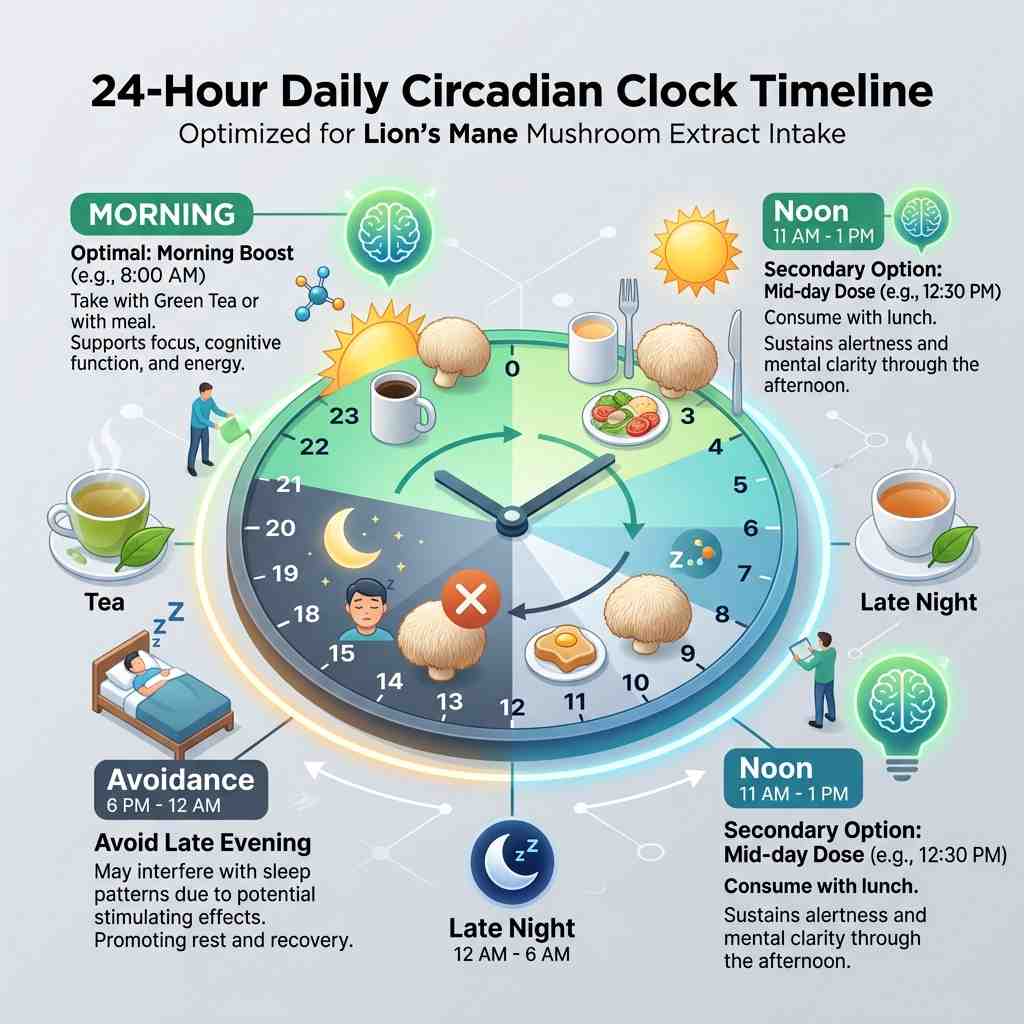
3. Circadian Timing: When is the Best Time of Day to Take Lion’s Mane?
To extract maximum neurological benefit from the recommended daily dose of lion’s mane, aligning your intake with natural circadian biology is critical:
- The Morning Power Window (7:00 AM – 9:00 AM): Taking your primary dose alongside morning green tea or coffee creates powerful synergy. The caffeine acts as an acute adenosine antagonist while Lion’s Mane provides steady, non-stimulatory neurotrophic support for 6 to 8 hours.
- The Mid-Day Refuel (12:00 PM – 1:30 PM): Consuming a secondary dose with a balanced lunch combats postprandial glucose dips and maintains afternoon executive momentum.
- Why Avoid Late Evenings (Past 5:00 PM): Because Lion’s Mane enhances cortical micro-circulation and stimulates neurogenesis, late-night ingestion can trigger intense dream activity, rapid eye movement (REM) hyperactivity, and delayed sleep onset.
For more foundational information on mushroom pharmacology and clinical safety, visit our master pillar guide on Lion’s Mane Dosage Guide for Nerve Growth.
4. Safety, Tolerability & Heavy Metal Screening Protocols
Because fungal organisms naturally bioaccumulate environmental minerals from their growing substrate, verifying the cultivation purity of your recommended daily dose of lion’s mane is essential. Unregulated mushroom powders imported without third-party ICP-MS testing can contain elevated trace quantities of lead, cadmium, or arsenic.
Always verify that your brand provides a third-party Certificate of Analysis confirming heavy metal levels well beneath California Proposition 65 limits (Lead < 0.5 mcg/day, Cadmium < 4.1 mcg/day, Arsenic < 10 mcg/day). Organic shade-house wood cultivation ensures optimal mineral safety and maximum secondary metabolite density.
5. Identifying Quality: Third-Party Beta-Glucan Testing
When selecting a supplement to meet your recommended daily dose of lion’s mane, always inspect the Certificate of Analysis (COA) for these three quality benchmarks:
- Guaranteed Beta-Glucan Content: Look for products guaranteeing at least >25% to >30% (1,3)(1,6)-beta-D-glucans via the Megazyme assay test method. Avoid brands that only list generic “polysaccharides,” which frequently hide grain starch.
- Starch Content (<5%): Quality mushroom extracts should contain under 5% total starch. High starch numbers confirm the presence of unfermented grain fillers.
- Dual-Extraction Verification: Ensure the product underwent both hot-water and organic ethanol extraction to capture both water-soluble polysaccharides and fat-soluble hericenones.
At Brooklyn Health & Wellness, our integrative practitioners evaluate neurochemical health, dietary protocols, and functional lab markers through comprehensive Holistic Health Consultations.
6. Frequently Asked Questions (FAQ)
What is the recommended daily dose of lion’s mane for memory?
The standard recommended daily dose of lion’s mane for memory enhancement is 1,000 mg to 1,500 mg daily of a standardized dual-extract taken in the morning with food.
Can you take too much Lion’s Mane?
Lion’s Mane has an exceptionally high safety profile in human clinical trials. Doses up to 3,000 mg daily have been administered for months with zero organ toxicity. However, consuming excessive unextracted raw powders (>10 grams) may cause mild stomach upset or loose stools.
Should Lion’s Mane be taken with food or on an empty stomach?
While water-soluble beta-glucans can be absorbed on an empty stomach, fat-soluble hericenones and erinacines are absorbed much more efficiently when co-ingested with a light meal containing dietary fats.
Does Lion’s Mane build a tolerance over time?
No. Lion’s Mane does not stimulate dopamine or adrenaline receptors directly, meaning it does not cause receptor downregulation or physical tolerance.